Pyramid Pose, Parsvottanasana. Let’s Talk about it.
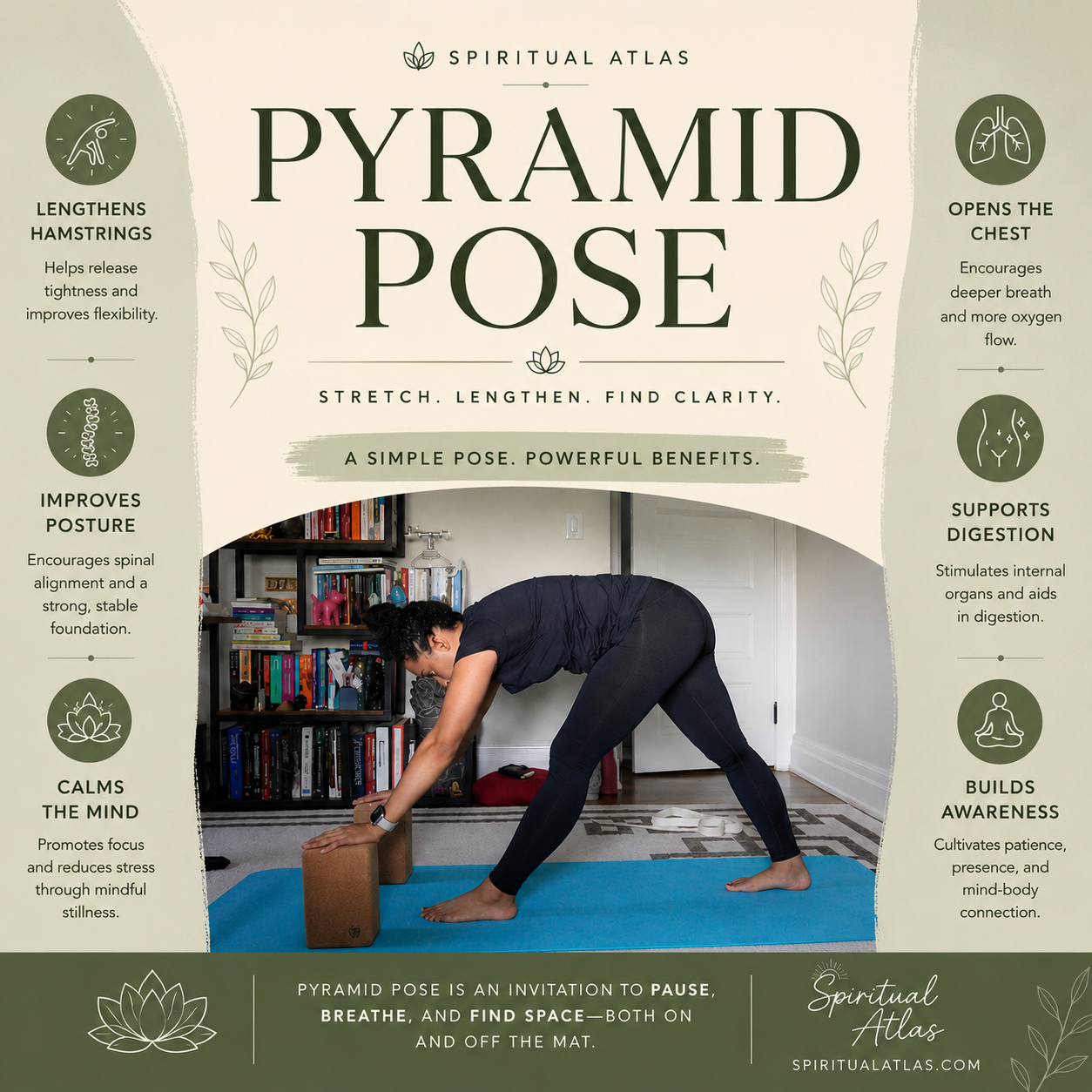
For my readers who do not practice yoga weekly or have never tried it, I’d advise you to
keep reading.
This blog is for you, especially if you are looking for ways to increase mobility, balance, and better your posture.
You can do Parsvottanasana, or pyramid pose, outside of the yoga studio and at any
time of the day. The pose doesn’t take long to enter, so you can do it anytime you have
a few minutes to spare and about five feet of space around you.
As a yogi of nearly twenty years, I am not considered a guru, nor do I do splits or hold
handstands for long periods. I teach foundational poses to help students enter a flow
where they can be present, achieve peace, and find stillness on their own. Honestly,
teaching helps me and my students be better humans every day, every minute, every
second. It is every human’s intent to harness the strength to persevere through any
obstacle faced before them, so for me it is yoga.
With that said, let’s dive into what pyramid pose does to the human body. Anatomically,
it is a closed hip pose, and improves mobility in the entire body by opening the
shoulders, engaging the core, and engaging the legs from hamstring to ankle. There is
also a squaring of the hips when coming into pyramid pose, which encourages better
posture.
Let’s get into Parsvottanasana:
1. Begin standing in Tadasana (Mountain Pose).
2. If you have yoga blocks, place them on top of the mat at each side.
3. Step your right foot about four feet behind you, keeping both legs straight and
toes forward.
4. Square your hips forward, drawing the left hip back and the right hip forward.
5. Place your hands on your hips.
6. Inhale to lengthen the spine.
7. Exhale and hinge from the hips to fold over the front leg, keeping the spine long.
8. Keep both legs active and avoid locking the knees.
9. Bring the back foot in to ensure both feet are on the ground.
10. Place blocks at any setting to support your hands when they are not on your
hips.
11. Hold for 5–10 breaths. To exit, inhale and slowly rise with a long spine.
12. Repeat on the other side.
13. To take this pose a step back, use a chair or table to support your hands.
14. To take this a step further, place your hands behind you in prayer, a bind, or with
clasped elbows.
In this pose, you will feel the engagement of both legs and the core, in addition to the
opening of the shoulders. Pyramid pose is simple but not underestimated, as it is a pose
of stillness yet focuses on lower body strength. In yoga, we embrace the journey of
improving your asana, or pose, but we also embrace the power of being present,
observant, focused, humble, and open to the union of your body, mind and spirit.
Give yourself grace with pyramid pose or any asana in yoga, as it is the journey that
lives the experiences and the non-judgement of progress. Happy movements. Namaste.
With gratitude,
Mary Love
